Showing posts with label advice. Show all posts

Sunday, May 31, 2020

[UK] Meeting in groups of up to six

Social distancing: A practical guide to how to socialise now
https://www.bbc.co.uk/news/uk-52848793

In England the 1st of June marks a new phase in the easing of lockdown measures. It may not be surprising that some people have become complacent and flouted "the rules" since lockdown began 10 weeks ago, but up until now government guidance has been fairly strict. Although there was some slight easing a few weeks ago to allow one-to-one socially distanced chats in public, there has been no official sanctioning of group get-togethers up until now. As of today government guidance for England allows for up to 6 people to meet outside (also in private settings) as long as people from different households stay two metres apart. This article provides a practical perspective and some advice on gathering safely.

Wednesday, April 1, 2020

To mask or not to mask?

Face-coverings are increasingly being recommended by authorities as a protective measure that helps prevent the spread of Covid-19, especially by those who are (unwitting) asymptomatic carriers.

"Asia may have been right about coronavirus and face masks, and the rest of the world is coming around" [CNN]

Please note: Nobody is advocating that N95 respirator masks, currently in such short supply, be worn by anybody except medical personnel.

Incidentally, N95 masks have a fascinating history that involves creepy bird masks, bra design, and karmic retribution for racism.

"The untold origin story of the N95 mask" [Fast Company]
https://www.fastcompany.com/90479846/the-untold-origin-story-of-the-n95-mask


Updated to add:
If you're not the crafty type, this tutorial will show you how to turn a T-shirt or handkerchief into a face mask.

"How to make a non-medical coronavirus face mask – no sewing required" [The Guardian]
https://www.theguardian.com/us-news/2020/apr/06/how-to-make-no-sew-face-mask-coronavirus

Saturday, March 28, 2020

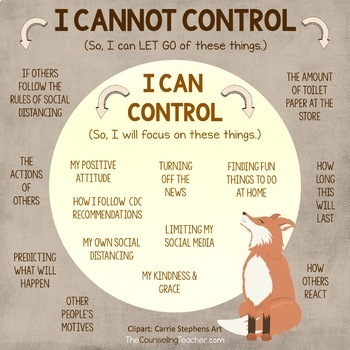
Things I cannot control and I can control


Text of graphic:

[Outside of full moon]
I CANNOT CONTROL (So, I can LET GO of these things.)
If others follow the rules of social distancing
The actions of others
Predicting what will happen
Other people's motives
The amount of toilet paper at the store
How long this will last
How others react

[Inside full moon with a fox gazing up at it]
I CAN CONTROL (So, I will focus on these things.)
My positive attitude
How I follow CDC recommendations
My own social distancing
Turning off the news
Finding fun things to do at home
Limiting my social media
My kindness & grace

Clipart: Carrie Stevens Art
TheCounselingTeacher.com

Graphic is from https://www.teacherspayteachers.com/Product/Coronavirus-Parent-Support-Graphic-5343091

Food safety and coronavirus

This article answers questions such as if food is a vector for transmission and the comparative risks between getting takeout, delivery, or cooking your own food.

https://www.seriouseats.com/2020/03/food-safety-and-coronavirus-a-comprehensive-guide.html

Tuesday, March 24, 2020

Social distancing in Shanghai

I.
It feels fitting to write this at a time when Hubei province and its capital city, Wuhan, have finally begun to emerge from their two-month lockdown. For the last few weeks, locally transmitted cases of Covid-19 are down to single digits; nearly all the new cases in China have been imported.

I’m an American who has lived in China for more than a decade; for the last five years, I’ve called Shanghai home. As I write this, the city is well on its way to returning to normal—and it’s clear we got off easy. The city's population is 25 million, but we've only had about 400 confirmed cases of Covid-19 and four deaths. It’s now quite obvious that Shanghai and the rest of China were spared the worst because of the draconian measures implemented in Hubei province to contain the coronavirus from spreading. Wuhan was fully locked down, with residents specifically instructed to stay indoors, bus and train service halted, and no outbound travel at all. Elsewhere in China, some other cities raised their alert levels as well, limiting the number of outings per household (e.g. one person could leave the house to buy groceries every two days). By contrast, in Shanghai, social distancing measures for individuals were more of an advisory than strictly mandated.

Offices, schools, shops, and restaurants here did close, but that wasn’t unusual—at first. You see, in China, normal life and business come to a standstill for a week every winter; the biggest cities empty out as people return to their hometowns to spend the Lunar New Year holiday with their families. Did that make the timing of the Covid-19 outbreak in China better or worse? It’s hard to say. The number of travelers criss-crossing the nation in mid- to late January no doubt hastened the spread of the virus to other provinces. On the other hand, schools were already shut and the entire nation was looking forward to hunkering down for a period of inactivity. We just never expected it to last so long.

Hubei province got the lockdown order on January 23, the day before Lunar New Year’s Eve. As news reports about the coronavirus grew increasingly grim, authorities extended the holiday from the usual week to 13 days ... then 18 days. Then office workers were encouraged to start teleworking and schools began using distance-learning platforms to restart classes. Late February came and went, and people were still staying indoors. Here in Shanghai, a handful of restaurants and shops stayed open throughout. Supermarkets were fully stocked. Empty buses continued to roll by on empty streets. In the evenings, I went out for my daily stroll. Everybody kept their distance.

II.
The first time somebody held up a contactless thermometer and told me to hold out my wrist, I felt personally affronted. “Maybe I don’t want to enter your grocery store!” I wanted to say, but instead, I quickly reminded myself that this wasn't personal. If I were a business owner, would I not owe a duty of care to my customers—not to expose them to contagion? Moreover, as someone who did not own a thermometer, how else was I going to find out if my temperature was actually running high? Inside the store, new signage at the cash registers requested cashless payments only. Here, too, I had to bow to logic. They didn’t want my grubby bills; I didn’t want them to make change with their germy coins. These new inconveniences were for my protection as well.

And yes, it was embarrassing to discover I’d been washing my hands wrong my entire life. The 20 seconds of sudsing and scrubbing recommended by doctors seemed like an eternity. But then I learned that soap does more than getting microbes slippery enough to sluice off. Apparently, soap molecules grab onto virus membranes and literally tear them apart—like a toddler demolishing string cheese. But only if you give the soap enough time to do its work. Suddenly, handwashing was transformed from an ordeal into delightful self-care.

I admit to being a late adopter of facemasks. In Asia, even before Covid-19, it was not unusual for people suffering from a cold to wear facemasks as a courtesy to others, but suddenly I was seeing them on every face. For a few days I went about barefaced—but felt increasingly self-conscious. By the time I realized masks were socially mandatory, there were none left to buy, either in the pharmacies or online. I tried pulling a scarf up around my face for a day or two, but I wasn’t fooling anybody.

In the end, I decided to make my own facemask. Would a DIY fabric mask ward off any Covid-19 pathogens that were determined to invade my mucous membranes? The science said no—only N95 masks actually offer substantive protection, but nobody out on the street was wearing an N95 mask. In other words, my DIY mask would be just about as effective as everybody else’s. Not that anybody would get close enough to judge my handiwork.

It was a fun sewing project. I had plenty of scrap fabric at home, but even the tasteful plaids and stripes seemed a bit garish. Eventually I found a black apron and cannibalized the fabric to make three washable/reusable facemasks. Tips for anyone embarking on their own DIY mask project: 1) If you’re not sure the fabric is 100% cotton or linen, do not iron with high heat. 2) Elastic ear loops are better than a behind-the-neck head strap. Ear loops all the way.

Only much later did I learn about the government rationing system that entitled me—after I registered with the local neighborhood committee—to purchase five surgical facemasks from a designated pharmacy. I consider that small stash of pleated blue masks to be my facemask “formalwear”—to be worn only in situations where I need to present my passport, like airports and train stations. The rest of the time, I still wear my DIY fabric masks. Somewhere along the way, I realized what masks mean. Covering one’s face with a thing that sometimes chafes and always fogs your glasses is inconvenient. Anybody who accepts this inconvenience is more likely to be taking other precautions as well, such as careful hand-washing and physical distancing. A mask says: I take this epidemic and its risks seriously. Once I realized that, wearing the mask no longer felt like a chore.

I don’t know what measures are being mandated by your local authorities or by the rapidly evolving norms of your community and neighborhood. Perhaps, in time, you too will submit to infrared temperature guns at the entrance to every store. Maybe you will eventually find yourself frowning at the thoughtlessness of those who go unmasked in public. Who can say?

III. 
So yes, adjusting to social distancing is a game of degrees. I did things on a Thursday that my Monday self would have balked at. The assumptions I held dear in early February seemed downright laughable by the end of that month. There are some types of new knowledge that the brain seems to need to incubate for days before the body can accept it. Lag is real; everybody’s behind the curve. We all acclimatize at our own pace. Just anticipate that things will continue to change. Keep listening to the experts.

Even under the best case scenario—if authorities in your country managed to enforce complete compliance with the precautions today—your country can look forward to several weeks of bad news. The numbers on the Covid-19 dashboards will rise like floodwaters. Haggard doctors and nurses will pause only to share their horror stories. When those moments come, I encourage you to respond not with despair but instead a renewed commitment to do your part, whatever that looks like: volunteering, donating, calling up your elected officials to urge support for crucial legislation ... or simply staying indoors and refusing to go stir-crazy.

A virus can’t spread if it can’t jump to the next host. The sooner everybody embraces social distancing, the faster we stomp the curve.

It has been instructive for me to ride out the Covid-19 outbreak in a country that is all too used to upheaval. China has experienced incredible prosperity over the past 30 years or so, but the national character was deeply shaped by the decades of chaos in the 20th century: foreign invasion, civil war, famine, and a Cultural Revolution. That’s all within living memory. So too is social solidarity and mass mobilization. In one WeChat group conversation, I saw one person praising their neighbor for self-isolating immediately after potential exposure to the coronavirus. “He has excellent moral fiber,” others exclaimed.

“We’re all doing our part. All of China is doing zuo yuezi,” another netizen quipped, referring to the traditional month-long confinement that new mothers undergo to restore their strength after giving birth. It was funny, but it did make me wonder: What were we giving birth to?

I can tell you this much: You're going to come out of this with a new set of habits. Your daily routines and rituals have been disrupted and you're consciously and unconsciously adopting new behaviors. All I’m saying is: Take this opportunity to form good new habits. For example, people who are cooped up at home may—at some point—find that consuming content all day breeds sluggishness, whereas creating something for others can lead to a flow state that is powerfully energizing. When your country’s curfew finally loosens and you fully re-emerge, the world will look different too. Your old instincts will bump up against the new habits ... and you get to choose which ones to take with you into the future.

IV. 
I admit that some anti-Covid-19 measures here in China that relate to monitoring and privacy have given me pause. The latest development is the Health Code, a mobile phone-based monitoring system that indicates whether the user has been in close contact with an individual who has contracted Covid-19. I understand why this exists. There are plenty of little old ladies on the streets of Shanghai, and if my using the Health Code helps protect them, so be it. Social solidarity (and the Chinese government) may yet demand something that today-me thinks is overkill. I can’t predict the future.

Has fear been motivating people in China to practice social distancing and voluntary isolation? (By fear, I mean both apprehension about the coronavirus and knowing that the government would not hesitate to enforce the protocols.) Yes, of course. But we—Chinese citizens and foreign expats alike—also followed the rules because we were concerned about our neighbors and our elders, we were moved by the stories coming out of Wuhan, we were buoyed by the feeling of shared sacrifice, and we were heartened when the case numbers began to drop. When your actions are being motivated by both anxiety and altruism, it feels better to focus on compassion.

V. 
Covid-19 has not been stamped out in China. For now, it has been controlled—we managed to press pause. And it only takes one asymptomatic or presymptomatic person with their respiratory droplets to start the dominoes falling again. But there is every reason to believe that new flareups can be contained quite quickly, now that the infrastructure is in place (and national pride is at stake). Everybody in China now knows what a fever and dry cough might indicate; the testing, quarantine, and treatment are extremely efficient; and in a health care system that is not overwhelmed, it is entirely feasible to do the painstaking contact-tracing that disrupts a hotspot from forming. I really hope I’m right about this.

VI. 
This was a popular cartoon that circulated on Chinese social media in February.


Let me explain what's going on. The patient in the isolation ward is a bowl of noodles: regan mian, a Wuhan specialty. The friends crowding the window to offer their love and support are foods representing several other Chinese provinces. They’re holding up signs that say: "Jiayou!" a phrase which translates to "Stay strong! Fight on!"

Jiayou is what you say to motivate athletes who are flagging or students about to take an important test; jiayou is all-purpose encouragement. In late January, one week into Wuhan’s strict lockdown—when nobody had any idea how long it might last—the people of the city began hollering solidarity to each other from their windows: “WUHAN JIAYOU!”

So why does a bowl of regan mian noodles represent Wuhan? Honestly, you'd be hard-pressed to find a more fitting mascot for the city. When I visited Wuhan two years ago, I snapped these photos on a busy street in the early morning.


It's not unusual in any big city to see commuters wolfing down breakfast as they hurry to catch a bus, but rarely does eating-and-walking involve a bowl and chopsticks. That's how much Wuhan folks love their regan mian.

Still not convinced? Here's the "NO EATING ALLOWED" poster for Wuhan public transit.


Now, as Wuhan wakes up from its nightmare, I like to imagine that little cartoon regan mian patient being discharged from the hospital. He's a bit frazzled from two months of confinement, but ready to rejoin the world and reconstruct “normal life” by exercising old muscles—and new ones as well.

And as the curfews sweep across the globe, as I browse photos of echoingly empty thoroughfares, watch videos of people serenading their neighbors from their balconies and giving nightly ovations for health care workers, the only thing I can say is: Jiayou, world! Fight on!

- Lilly

Sunday, March 22, 2020

Saturday, March 21, 2020

Social distancing explained in 11 seconds


Pretty clever, no? Such an elegant way to illustrate how simple choices can disrupt exponential spread. The more people who see this visualization, the better.

Luckily for all of us, Siouxsie Wiles and Toby Morris of The Spinoff have thoughtfully designated this GIF as CC-BY-SA. That means you're encouraged to share, repost, and republish it—just don't forget to give credit where it's due!

Thursday, March 19, 2020

Debunking misinformation

So you're doing your best to seek out and follow expert advice, and that's fantastic. But maybe you have an aquaintance who swears that hot baths, UV lamps, or garlic-infused saline wash will ward off the coronavirus. You're highly skeptical. You're trying to convince them otherwise, but you could use some scientific backup.

Never fear, the World Health Organization is here to help.

Coronavirus disease (COVID-19) advice for the public: Myth busters [WHO]
https://www.who.int/emergencies/diseases/novel-coronavirus-2019/advice-for-public/myth-busters

Rethinking the way we do laundry and package delivery

If you're the type of person who believes "You can't be too careful!" when it comes to potential exposure from surfaces, here are some handy guides to doing laundry and receiving packages in the Covid-19 era. Tips range from recommended detergents to contact-free delivery.

How Long Coronavirus Lives On Clothes, And How To Wash Them [Huffington Post]
https://www.huffpost.com/entry/how-long-coronavirus-live-clothing-washing_l_5e724927c5b6eab779409e74

How To Open And Clean Delivery Packages During The Coronavirus Pandemic [Huffington Post]
https://www.huffpost.com/entry/how-to-get-packages-during-coroonavirus_l_5e7375cbc5b6f5b7c53f3562

UK press conference summaries

Sunday 22 March 2020
- Thanks to everyone working to keep the country going, including those in social care, distribution, transport, and every other sector; anyone who has communicated with their mothers from a distance today on Mother's Day; and thanks to everyone forced to close a business for making this sacrifice.
- Special steps will be taken to protect the vulnerable (1.5m total identified by the NHS with highest risk of being hospitalised). NHS will contact these people by letter (to start landing by Tuesday) followed up by text and/or phone call as necessary, and urge them to stay at home for 12 weeks (full list of relevant medical conditions is already online - see gov.uk link below). Letters will include resources for mental health. Distribution list may be slightly overestimated to ensure that everyone who needs to be included is informed. GPs can raise the issue for any other patients they believe to be in the high-risk category. Government's message to these individuals: you are not alone.
- Shielding measures will do more than any other single measure to save lives and reduce the spread. We owe it to those working so hard on the frontline to make an effort to shield the most vulnerable to help save their lives.
- For those who are vulnerable and self-identify as having no support network (via website and phone number provided in letter), the government is working around the clock to create a safety net of local hubs which will deliver medicines, groceries, and other essential items. Supermarkets and other existing businesses and agencies (including armed forces) will be involved and there will also be opportunities for the public to volunteer. The hope is for the first deliveries to be made at the end of next week. Food parcels will start off being generic and then may be adapted to individuals.
- Don't send your child to school unless you're a key worker.
- Going outdoors is important for health and well-being but must be done responsibly in line with advice for social distancing. Stay 2 metres apart. Even if you feel you are safe, you can infect others. For every one adhering to the measures, you are doing your bit to slow the disease, and the more we do this collectively, the more time we give the NHS to save lives, and get through this crisis faster.
- Outdoor environments are generally safer than indoor but should not be combined with social contact. Those who are congregating in any areas are making them dangerous for those who need to go out. Proximity is the problem.
- Epidemiology suggests that smallish gatherings (e.g. family coming together on Mother's Day) are riskier than larger ones due to the personal nature and people having closer physical contact.
- Be cautious about making direct comparison of numbers from another country such as Italy.
- Specific hospitals are struggling with a shortage of beds and ventilators as had been predicted, but there are flex plans to offer additional support. There are efforts currently being made to massively increase the amount available.
- Government interventions must be introduced at the right time to have the maximum effect.
- If people don't follow advice properly, tougher measures may have to be introduced (e.g. closing playgrounds).
- The most important general advice: stay at home if you possibly can.

Friday 20 March 2020
Today's wide-ranging UK press conference:
- PM reiterated advice of staying at home, avoiding unnecessary social contact, washing hands, etc.
- Cafes, pubs, bars, restaurants, nightclubs, theatres, gyms, leisure centres are being told to close ASAP tonight, although takeout food can still be sold. This will be reviewed on a monthly basis.
- The speed of recovery depends on the public's compliance with measures
- People may be tempted to go out but should not - you're endangering yourself, your family, and everyone else and hindering progress against the virus
Chancellor announced "unprecedented measures in scope and scale":
- Coronavirus job retention scheme is being introduced to protect people's jobs and incomes
- For the first time in history government will step in and help pay people's wages
- All employers can apply for grants to cover 80% of employees' salaries up to £2.5K per month, backdated to 1st March and for 3 months, with an extension if necessary, and with no upper limit so that employees can be furloughed instead of laid off
- Previously announced loans will now be interest free for 12 months and available starting on Monday
- Deferment of next quarter of VAT payments until end of June
- Universal credit increased £1K for next 12 months
- Working tax credits also increased £1K for next 12 months
- Self employed to receive protection as well (can claim universal credit equivalent to statutory sick pay for employees)
- Self assessment payments deferred until January 2021
- Local housing benefit will cover at least 30% of rent
- We want to look back on this time for its atmosphere of kindness and decency and collective national effort
Questions from press:
- In regard to Mother's Day, people should think very carefully about visiting any elderly person and/or those in vulnerable groups
- Transport is too important for delivery of services to be shut down
- Wage initiative covers anyone in PAYE scheme
- Social distancing applies to children as well. If you go outside then do so in a manner which reduces social contact (e.g. bike ride 2 metres apart). Do exercise but not in groups and cut out the associated social connections (sitting in car together or meeting in close contact indoors).
- The country has an adequate supply of personal protective equipment (PPE). There were bottlenecks which have now been resolved.
- Parties at home: government can't forbid every form of socialising but the risk is that anybody, including young people, can become vectors of the disease
- Charities will benefit from the schemes and interventions introduced this week. Funding may be increased for local voluntary groups.
- PM emphasised two takeaways: we're telling these places to close and it's heart-wrenching, but government has introduced economic measures not just to support businesses but individuals

Thursday 19 March 2020
Statement from PM:
- Thank you to everyone for efforts and sacrifices being made
- Projected timeline of turning the tide within the next 12 weeks
- First patient in UK has been enrolled in a trial for drugs to treat the virus and trials for a vaccine will start in mid-April
- Test for antibodies is being developed to determine whether an individual has already had the virus
- Please follow all advice scrupulously and we must all pull together
- Collective efforts and scientific progress will determine our success
- PM: Businesses, stand by your employees, and the government will stand by you
Responses to questions from the press:
- People are urged to avoid gatherings but there is "no prospect" of shutting down the Tube
- Testing is crucial to defeating the virus
- ICU capacity particularly in London hospitals is under pressure and 3 points are necessary to mitigate this:
1)people need to practice social distancing to pull down the peak
2)NHS needs to add beds
3)NHS staff need to be tested as a matter of urgency so they can reliably work on the frontline
- The great majority of people will have milder symptoms, including children
- Severe cases usually occur in medically vulnerable people (over 70s and those with underlying conditions) but are not limited to those groups so even younger people must take the threat of the virus seriously

Wednesday 18 March 2020
Takeaways:
- UK schools to shut from Friday afternoon until further notice to help flatten the curve for ICUs
- Provision will be made for children of key workers (NHS staff, police, etc.) and the most vulnerable children
- Provision will be made to supply meals or vouchers to children in need
- Exams in May and June will be cancelled
- Chief Scientific Adviser now stresses the importance of monitoring all cases including those who are asymptomatic
- There will be a movement toward home-based tests for the virus or other methods of testing which minimise contact
- There will be measures to help protect renters
- PM not completely ruling out possibility of stricter ("further and faster") measures to limit movement of populace
- Modelling takes into account that not all will comply with guidelines but as many as possible must take advice seriously in order to protect the most vulnerable and mitigate suffering
Additional important points:
- It is unclear whether the shutting of "all schools" includes private schools, nurseries, higher and further education
- Government is introducing legislation to ban evictions of renters for next 3 months

Ideas for surviving non-stop together time with your significant other

Some background:
My husband Keith and I are both translators and have been working from home together for nearly 10 years now. Someone in one of my American expat groups asked me how the two of us have managed to preserve our own space (and probably our relationship!) and I said I would give it a think.
Keith has a steady work pattern and basically does a 9 to 5, whereas I mix it up more with work and other responsibilities, so I usually flit around a lot more during the day and do household tasks (like laundry), drive to the supermarket, or meet with friends or groups. He and I have also made massive efforts to develop hobbies and friendships individually so up until now we've been taking turns going out at night (we can't usually both go out because we have kids). Over the past year there were often weeks when we'd only spend one evening a week together!
So now we come to the present day and here are my suggestions.
- HAVE A PLAN: I think having a plan is essential for staying sane and making sure everyone's happy. My take on it is that you need to force yourselves to have time apart. Even if you're at home, take a big break from each other regularly. (For those of you who have kids who will be home with you every single day, let's consider the kids as a single unit with one parent, so if I say "I" that could for example mean "the kids and I").
- GO OUTSIDE: If you're not both fully self-isolating (e.g. showing symptoms or high-risk) then at least one of you can go outside for an hour every day. Going outside in the fresh air is still allowed and different from being in a confined indoor space - you just have to keep your distance (I've seen a recommendation of 6 feet) from other people. You can walk in a less congested neighborhood or in a park or any other less populated space you can think of. In the UK the National Trust is working on keeping the outside areas of their properties open so check that this applies to any National Trust properties near you for a more pleasant change of scenery.
- DO SEPARATE THINGS AT HOME: Earlier this week I suggested to Keith that he should schedule online gaming sessions with his best friend. They don't usually do this because Keith prefers going out and seeing people in person, but of course that's not a good option right now, so the online interaction provides an alternative for connecting with a friend. What else can you do separately? The usuals, but carve out your "me" time even if you're not sick of each other yet. Be proactive about not spending every second together. So you should agree to go into separate rooms (or as far apart as possible in your home) and do your own thing e.g. a workout, listen to music, read a book, watch TV, play a game, call a friend, write a letter, catch up on e-mail, organize your stuff, do a video chat with friends, etc. etc. etc.
- DO THINGS TOGETHER IN AN ONLINE GROUP WITH OTHER PEOPLE: I've been anxious about the prospect of not being able to interact with anyone outside the home so I've been investigating options for playing party games online and found some ways to do a game night with friends (check out this post for more ideas). Or you could do a "pub night at home" (using Zoom, Google Hangouts, etc.) together with your partner and your mutual friends. I have a game night with friends in the pipeline and can let everyone know how it goes. I've always found that hanging out as a couple with other people is pretty different from just hanging out one-on-one and it really helps you feel like you're mixing things up.
Those are my initial ideas which I hope will help someone out there.
-Jennifer

Tuesday, March 17, 2020

Take Control of Working From Home Temporarily book

Glenn Fleishman @GlennF on Twitter:

"@neilhimself My publisher and I worked together to write this free 55-page book last week on suddenly having to work from home—creating a space, using new online tools, setting work/home boundaries, being good to yourself. If you find worthwhile to share: https://t.co/EJZbHgegB7"

https://www.takecontrolbooks.com/working-from-home/

Tips for working from home

Coronavirus: Five ways to work well from home [BBC]
https://www.bbc.co.uk/news/business-51868894

Working from home tips from our experienced remote employees [Stack Overflow]
https://stackoverflow.blog/2020/03/12/working-from-home-tips-from-our-experienced-remote-employees

Social Distancing: This is Not a Snow Day

http://medium.com/@ariadnelabs/social-distancing-this-is-not-a-snow-day-ac21d7fa78b4

Coronavirus and your wellbeing

This article from Mind (UK mental health charity) includes many helpful tips broken down by topic, including a checklist for preparing for two weeks of self-isolation.

https://www.mind.org.uk/information-support/coronavirus-and-your-wellbeing/


UK government guidance on social distancing

https://www.gov.uk/government/publications/covid-19-guidance-on-social-distancing-and-for-vulnerable-people/guidance-on-social-distancing-for-everyone-in-the-uk-and-protecting-older-people-and-vulnerable-adults